Becket Stories Project is a community initiative that celebrates the local landscape and culture through storytelling, oral histories, and photographs, offering locals and visitors a space to share what makes this area special.
Becket Stories
STORYTELLERS
Name — Time periods mentioned — Topics covered
Bob Alarie — 1980s, 1990s, 2000s, 2010s, 2020s — Newcomers & Belonging, Coming Home, The Land
Linda & Dave Bacon— 1940s, 1950s, 1960s, 1970s, 1980s, 1990s, 2000s, 2010s, 2020s — Family Roots, Childhood & Growing Up, The Land, Bars & Gathering Places, Making a Living, The Summer Camps
Holly Brouker — 1960s, 1970s, 1980s, 1990s, 2000s, 2010s, 2020s — The Land, Jacob's Pillow & the Arts, Coming Home, Newcomers & Belonging
Rita May Furlong— 1940s, 1950s, 1960s, 1970s, 1980s, 1990s, 2000s, 2010s, 2020s — Family Roots, Childhood & Growing Up, Civic Life, Making a Living, The Land, Music & Performance, Coming Home
Katey Gray— 1970s, 1980s, 1990s, 2000s, 2010s, 2020s — The Land, Water & Lakes, Coming Home
Mark Hanford — 1970s, 1980s, 1990s, 2000s, 2010s, 2020s — Bars & Gathering Places, The Land, War & Service
Billy Hoch— 1960s — The Summer Camps, Childhood & Growing Up
Matty Beatty, Nolan Raymer, & Everett Massini — 2000s, 2010s, 2020s — Childhood & Growing Up, The Land, The Summer Camps, The School, Making a Living
Purr McEwen — 1950s, 1960s, 1970s, 1980s, 1990s, 2000s, 2010s, 2020s — Water & Lakes, Family Roots, Childhood & Growing Up, Jacob's Pillow & the Arts, The Summer Camps, Newcomers & Belonging, Civic Life, The General Store, The Land, Coming Home
Bill Mulholland — 1940s, 1950s, 1960s, 1970s, 1980s, 1990s, 2000s, 2010s, 2020s — Music & Performance, Family Roots, War & Service, Jacob's Pillow & the Arts, The School, Civic Life, Bars & Gathering Places, Childhood & Growing Up, Coming Home
Olivia Pattison — 2020s — The General Store, Newcomers & Belonging, Making a Living, Coming Home
Deb Rivel— 2000s, 2010s, 2020s — Coming Home, Newcomers & Belonging
Barbara Roberts— 1890s, 1900s, 1910s, 1920s, 1930s, 1940s, 1950s, 1960s, 1970s, 1980s, 1990s, 2000s, 2010s, 2020s — Family Roots, Childhood & Growing Up, The General Store, The Land, Making a Living, The School, War & Service
Kathy Rodhouse — 1950s, 1960s, 1970s, 1980s, 1990s, 2000s, 2010s, 2020s — Family Roots, Jacob's Pillow & the Arts, The Summer Camps, Childhood & Growing Up, The School, Water & Lakes, The Land, Bars & Gathering Places, Coming Home
Will Rodgers — 1950s, 1960s, 1970s, 1980s, 1990s, 2000s, 2010s, 2020s — Childhood & Growing Up, War & Service, Making a Living, The School, Coming Home
Elizabeth Shrader — 1960s, 1970s, 1980s, 1990s, 2000s, 2010s, 2020s — Water & Lakes, Childhood & Growing Up, The General Store, Coming Home
Bobby & Tina Sweet — 1920s, 1930s, 1940s, 1950s, 1960s, 1970s, 1980s, 1990s, 2000s, 2010s, 2020s — Music & Performance, Family Roots, Bars & Gathering Places, Childhood & Growing Up
BECKET PAST & POSTCARDS
FIRST INHABITANTS
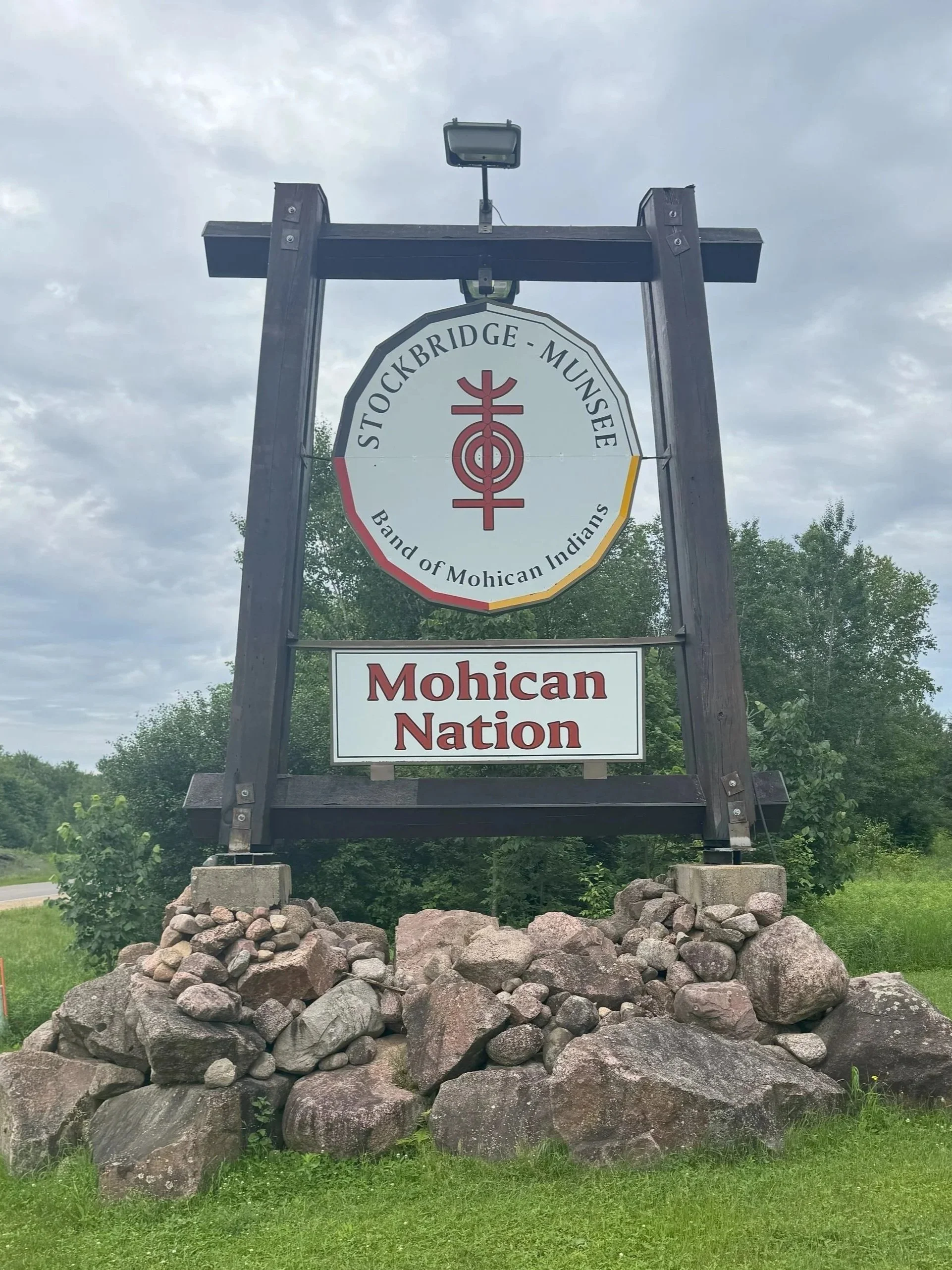
The original inhabitants of Becket and the surrounding region were the Mohican people, whose official name today is the Stockbridge-Munsee Community, also known as the Mohican Nation or the Stockbridge-Munsee Band of Mohicans. The Tribe's original territory spans the Hudson, Housatonic, and Delaware River Valleys. Their name derives from the Muhheacannituck, "People of the waters that are never still", also known as the Hudson River.
Archaeological evidence of the Mohicans stretches back 12,000 years in the Hudson Valley region. Mohican sachem John Waunaucon Quinney recounted that in 1604 the Muhheconeew Nation numbered 25,000. After the arrival of Dutch and English settlers, pandemic disease and violent conflict brought devastating losses, while land theft became widespread. Even when Europeans did attempt to "purchase" Mohican and lands in the Berkshires and Hudson River Valley, their understanding of such transactions was at odds with that of the Tribe, who adhered to a model of shared land stewardship and gift exchange.
By 1734, the Mohicans accepted an offer to relocate to Stockbridge, Massachusetts called "Indiantown", and co-govern the town with four English families. Yet even after serving in the Revolutionary War and earlier colonial conflicts, the Stockbridge Mohicans were no longer welcome in their own homelands. By the 1780s they began leaving Stockbridge and accepted an invitation to live among the Oneida Nation in western New York, where they rebuilt, started new enterprises, and continued to pursue land claims.
Pressure to remove Native people from New York State grew intense, however, and Tribal leaders sought other destinations. One band traveled to the White River in Indiana at the invitation of the Miami people, only to find that the land had already been ceded under the Treaty of St. Mary's. From there, the community splintered: some went to Kansas, others returned to New Stockbridge, New York. By the 1820s, most of the Tribe had relocated to Kaukauna, Wisconsin, and through the 1840s to an area on Lake Winnebago they named Stockbridge. Finally, in 1856, the Tribe signed a treaty with the Menominee Nation for the land where they still reside today, in Shawano County, Wisconsin. They continue to return to and protect their ancestral cultural places in their northeastern homelands.
Mohican History Walking Tours of present day Stockbridge can be accessed here.
ADDITIONAL RESOURCES
The Mohican Peoples: Their Lives and Their Lands Curriculum A Brief History of The Stockbridge-Munsee Community Mohican Miles Exhibit Words of our Ancestors Stockbridge Walking Tour Historical Panels in Mohican Homelands Long Journey Home: The Return of Papscanee Island Arvid E. Miller Memorial Library and Museum Native American Heritage Trail Official Tribal Website Arvid E. Miller Memorial Library and Museum Tribal History Timeline
Thank you to our sponsors